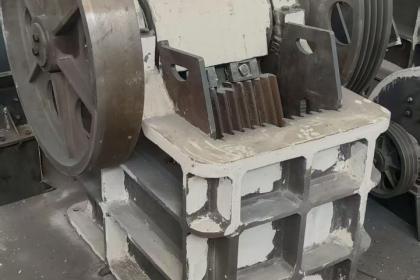
颚式破碎机鄂破破石机粉碎机鄂破机PE250x400
颚式破碎机又作鄂式破碎机,简称颚破,主要用于对各种矿石与大块物料的中等粒度破碎,广泛运用于矿山、化工、冶炼、建材、公路、铁路、水利和化工等行业。可对抗压强度不大于320MPa的各种矿石、岩石等物料进行粗、中碎作业,是矿石破碎机、煤矸石破碎机等矿石物料破碎的设备。性能特点为破碎比大,产品粒度均匀,结构简单,性能可靠,维修简便,运营费用低。
主要部件
1.机架
机架是上下开口的四壁刚性框架,用作支撑偏心轴并承受破碎物料的反作用力,要求有足够的强度和刚度,一般用铸钢整体铸造,小型机也可用优质铸铁代替铸钢。大型机的机架需分段铸成,再用螺栓牢固链接成整体,铸造工艺复杂。自制小型颚式破碎机的机架也可用厚钢板焊接而成,但刚度较差。
2.颚板和侧护板
定颚和动颚都由颚床和颚板组成,颚板是工作部分,用螺栓和楔铁固定在颚床上。定颚的颚床就是机架前壁,动颚颚床悬挂在周上,要有足够的强度和刚度,以承受破碎反力,因而大多是铸钢或铸铁件。
3.传动件
偏心轴是破碎机的主轴,受有巨大的弯扭力,采用高碳钢制造。偏心部分须精加工、热处理、轴承衬瓦用巴氏合金浇注。偏心轴一端装带轮,另一端装飞轮。
4.调节装置
调节装置有楔块式,垫板式和液压式等,一般采用楔块式,由前后两块楔块组成,前楔块可前后移动,顶住后推板;后楔块为调节楔,可上下移动,两楔块的斜面倒向贴合,由螺杆使后楔块上下移动而调节出料口大小。小型颚式破碎机的出料口调节是利用增减后推力板支座与机架之间的垫片多少来实现。
5.飞轮
颚式破碎机的飞轮用以存储动颚空行程时的能量,再用于工业形成,使机械的工作符合趋于均匀。带轮也起着飞轮的作用。飞轮常以铸铁或铸钢制造,小型机的飞轮常制成整体式。飞轮制造,安装时要注意静平衡。
6.润滑装置
偏心轴轴承通常采用集中循环润滑。心轴和推力板的支撑面一般采用润滑脂通过手动油枪给油。动颚的摆角很小,使心轴与轴瓦之间润滑困难,常在轴瓦底部开若干轴向油沟,中间开一环向油槽使之连通,再用油泵强制注入干黄油进行润滑。
Jaw cer | Jaw cer | Jaw cer | Jaw cer | Jaw cer | Jaw cerPE250x400
Jaw cer is also called jaw cer for short. It is mainly used for medium-sized cing of various ores and large materials and is widely used in mining, chemical industry, smelting, building materials, highway, railway, water conservancy and chemical industry. It can perform coarse and medium cing operations on various ores, rocks and other materials with compressive strength not greater than 320 MPa. It is the preferred equipment for cing ore materials such as ore cers and gangue cers. The performance characteristics are large cing ratio, uniform product particle size, simple structure, reliable performance, easy maintenance and low operating cost.
Main components
1. Rack
The rack is a four wall rigid frame with upper and lower openings, used to support eccentric shafts and withstand the reaction force of ced materials. It requires sufficient strength and rigidity, and is generally cast as a whole with cast steel. High quality cast iron can also be used instead of cast steel for small machines. The frame of a large machine needs to be cast in sections and firmly connected into a whole with bolts, and the casting process is complex. The frame of a homemade small jaw cer can also be welded with thick steel plates, but the rigidity is poor.
2. Jaw plate and side guard plate
Both fixed jaw and movable jaw are composed of jaw bed and jaw plate. The jaw plate is the working part, fixed on the jaw bed with bolts and wedges. The fixed jaw bed is the front wall of the frame, while the movable jaw bed is suspended on the periphery and needs sufficient strength and rigidity to withstand the cing reaction force. Therefore, most of them are cast steel or iron parts.
3. Transmission components
The eccentric shaft is the main shaft of the cer, which is subjected to a huge bending torque and is made of high carbon steel. The eccentric part requires precision machining, heat treatment, and Babbitt alloy casting for the bearing lining. One end of the eccentric shaft is equipped with a pulley, and the other end is equipped with a flywheel.
4. Regulating device
The adjustment device can be of wedge type, pad type, hydraulic type, etc. Generally, wedge type is used, consisting of two wedge blocks in front and back. The front wedge block can move forward and backward to support the rear push plate; The rear wedge block is an adjustable wedge that can move up and down. The inclined surfaces of the two wedge blocks are aligned in the opposite direction, and the screw moves the rear wedge block up and down to adjust the size of the discharge port. The adjustment of the discharge port of a small jaw cer is achieved by adjusting the number of shims between the thrust plate support and the frame after adding or removing.
5. Flywheel
The flywheel of the jaw cer is used to store the energy during the empty stroke of the moving jaw, which is then used for industrial formation to make the mechanical work more uniform. The pulley also functions as a flywheel. Flywheels are often made of cast iron or cast steel, and flywheels for small machines are often made as a whole. When manufacturing flywheels, attention should be paid to static balance during installation.
6. Lubrication device
Eccentric shaft bearings usually use centralized circulation lubrication. The support surfaces of the spindle and thrust plate are generally lubricated with grease through a manual oil gun. The swing angle of the moving jaw is very small, making it difficult to lubricate between the spindle and the bearing. It is common to open several axial oil grooves at the bottom of the bearing, and a circumferential oil groove in the middle to connect them. Then, a grease pump is used to forcibly inject dry butter for lubrication.