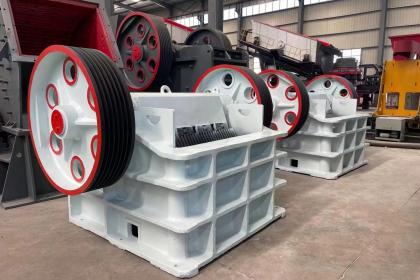
pe颚式破碎机长期供应矿石颚式破碎机PEX250×1000
颚式破碎机设备广泛应用于矿山、建材、化工、冶金等行业,可对抗压强度不大于320MPa的各种矿石、岩石等物料进行粗、中碎作业。使用范围
密封颚式破碎机主要对矿石、煤或其他中等强度物料中碎和细碎。其破碎方式为曲动挤压式,依靠两块耐磨颚板将物料挤碎。被破碎物料应为脆性,破碎后的物料形状呈片状居多,被破碎物料的抗压强度不超过80MPa。物料含水量超过8%会出现下料不通畅。
本机设计合理、维修方便,操作使用简捷。具有破碎比大、物料粒度均匀、调节简单、接料方便、全密封粉尘少等特点。机器结构先进、设计合理、运转平稳、振动小、噪声低等特点,在冶金、采矿、煤炭、炼焦等行业得到广泛应用。
小机型为化验室破碎制样使用。为全密封式,无粉尘泄露。电压380V和220V任选。
工作原理
颚式破碎机在工作过程中由电动机驱动皮带和皮带轮,通过偏心轴使动颚上下运动,当动颚下行时,定颚与动颚间夹角变小,物料被压碎达到破碎目的;当动颚上升时,定颚和动颚间夹角变大,动颚板在拉杆、弹簧的作用下离开定颚板,此时已破碎物料从破碎腔下口排出。
结构概述
破碎机主要有机体、偏心轴、静颚、动颚、调整装置、传动装置、动力部分等组成。
机体采用两种结构形式,整体铸造型和优质钢板焊接型,并由多条加强筋组成整体箱体。偏心轴由优质碳结钢制成,并车制成偏心。两端装有轴承并紧固在机架上。动颚有整体铸造和焊接结构两种形式。动颚和机架上固定有一对ZGMn13铸成的颚板。当电机带动皮带轮、并通过偏心轴驱动动颚进行往返运动时,由颚板将物料压碎,达到破碎的目的。
偏心轴上装有皮带轮,电动机的动力通过三角皮带传递,使机器工作。另一端装有飞轮,它可以积蓄动力,增加破碎力度。大型机还铸造有偏心块,使机器运转到破碎点时,偏心块积蓄的动能释放出来,增加破碎力度。
调整装置主要用来调整排料口的大小的,大小与产量成正比,改变撑板位置,料口间隙就能得到调整。实验室用小型机调节装置装在机器后部,松开滚花螺栓,转动手轮进行调整,顺时针出料粒度小,反之粒度大。大型机型靠多层垫板的加减进行调整。撑板系统不但能调整间隙,还能起到保险作用,喂料超载时,或遇到铁器时,它会弯曲或折断,使机器停止工作,保护其他零件不被破坏。为了保护机架长期使用,在机架的两边装有护板,以保护机体不被磨损。
安装试车
机器须安装在避雨的地方,尽可不露天安装。
电机须安装在破碎机的后方,机器有四条地脚螺丝固定在混凝土地基上,地基要留出排料口,其斜度不小于50度。
实验用的小型破碎机可以不打地基,也不用考虑排料,但要放在平整的地面或工作台上,并垫一层5毫米左右的橡胶板,以达到平稳和减震的作用。
破碎机与其他设备配合使用,须从方便生产、有利作业等方面统筹安排。
破碎机安装完毕,并超过地基凝固期后,方可进行试车。试车前再检查一遍所有螺丝是否拧紧,各连接零件是否可靠接触。然后先用人力转动皮带轮,确认为运动不受阻碍时,即可进行空车试验,空车试验两小时后,观察机器无冲击、无噪音,密封处无漏油,皮带轮和飞轮无摆动。机件无松动等现象,轴承温升不超过65℃。若发现以上故障,必须立即停车进行检修。确认破碎机试运转正常后,即可进行负荷试车。采用次硬度或小块度物料进行工作,如无故障,即可进行正常生产。五、使用维护及注意事项 破碎机必须在空载下启动。启动前仔细检查各部件的紧固情况、弹簧的弹性情况、皮带的松紧情况。
出料粒度的调整:可将机器后端调整手柄锁紧螺钉松开,顺时针为调小,反之则大。可同时观察颚板的间隙,调整合适的间隙后,要人工转动机器转够两转以上,方可启动电机进行工作。不允许调整间隙后直接启动电机进入工作。
当破碎颚板磨损严重,无法使用时,可将颚板颠倒过来,可以继续使用。
为了保证机器长期良好使用,对各活动机构及轴承内经常加注钙基脂,撑板与滑块、撑板与动颚支点每15天加油一次、各轴承内每30天加油一次。
破碎机启动后运转速度达到正常速度后,方可喂料,无料斗的机器,加料应从正前加入,不需从侧面加入,以防止机器过载和颚板偏斜造成事故。并严格防止钢铁,超硬度岩石进入机器,以免损坏机件。
每班启动时,要仔细检查破碎机的齿板是否松动,工作中要经常性地观察检查齿板的工作情况,发现异常情况时,要停止工作,彻底处理并排除故障,防止齿板的松动或位移而挤坏机器。运转时,严禁任何清理工作和安装撤卸皮带,禁止用手或撬杆从装料口内取出矿石,或移动大块矿石的位置,防止事故发生。停车之前,必须先停止给机器供料,待机器内的物料全部吐出完后,方可停车。
破碎机用三角皮带传动,要经常检查皮带的使用情况,如其中30%皮带损坏严 重,就必须全部换新的三角带,不可新旧混用,已免减少功率,影响生产效率。
破碎机每年进行一次撤机保养。每两年进行一次大修。
PE Jaw Cer | Long-term supply of ore 60PE Jaw Cer PEX250×1000
Jaw cers are widely used in mining, building materials, chemical, metallurgical, and other industri are capable of performing coarse and medium cing operations on various ores, rocks, and other materials with a compressive strength not exceeding 320MPa.
**Scope of Appli*
The sealed jaw cer is primarily used for medium and fine cing of ores, coal, or other medium-strength materials. Its cing method is a reciprocating compression type, re on two wear-resistant jaw plates to c the material. The material to be ced should be brittle; the shape of the ced material is mostly flaky, and the compressive strthe material does not exceed 80MPa. If the moisture content of the material exceeds 8%, the discharge will be obstructed.
This machine features a reasonable design, easymaintenance, and simple operation. It is characterized by a large cing ratio, uniform particle size, simple adjustment, convenient discharge, and low dust due to full sealing. With advanced structurenable design, stable operation, low vibration, and low noise, it is widely used in metallurgy, mining, coal, coking, and other industries.
The small modelfor cing and sample preparation in laboratories. It is fully sealed with no dust leakage. Voltage options are 380V or 220V.
**Working Principle**
Durig operation, the jaw cer is driven by an electric motor through belts and pulleys. The eccentric shaft causes the movable jaw to move up and down. When the movable jaw moves dd, the angle between the fixed jaw and the movable jaw decreases, cing the material to achieve the cing purpose. When the movable jaw moves upward, the angle between the fixed jaw and theaw increases. Under the action of tie rods and springs, the movable jaw plate moves away from the fixed jaw plate, and the ced material is discharged from the lower outlet of the crusg chamber.
**Structural Overview**
The cer mainly consists of the frame, eccentric shaft, fixed jaw, movable jaw, adjustment device, transmission device, and power section.
The framo structural forms: integral casting and high-quality steel plate welding, composed of multiple reinforcing ribs to form an integral box structure. The eccentric shaft is made of high-quality carbon structureel and machined into an eccentric shape. Bearings are installed at both ends and fixed to the frame. The movable jaw has two forms: integral casting and welded structure. A pair o plates made of ZGMn13 are fixed on the movable jaw and the frame. When the motor drives the pulley and the eccentric shaft drives the movable jaw to procate, the material is ced by the jaw plates to achieve the cing purpose.
A pulley is installed on the eccentric shaft, and the power of the motor is transmitted thro a V-belt to make the machine work. A flywheel is installed at the other end, which can accumulate power and increase cing force. Large machines are also cast with eccentric blocks, hat when the machine runs to the cing point, the kinetic energy accumulated by the eccentric blocks is released to increase the cing force.
The adjustment device is mainly used to adjust the size of targe opening. The size is directly proportional to the output. By changing the position of the toggle plate, the discharge gap can be adjusted. The adjustment device of the small laboratory machine installed at the rear of the machine; loosen the knurled bolt and turn the handwheel to adjust. Clockwise rotation results in smaller discharge particle size, and vice versa. e models are adjusted by adding or removing multiple layers of shims. The toggle plate system not only adjusts the gap but also serves as a safety device. When the feeding is overloaded ounters metal objects, it will bend or break, stopping the machine to protect other parts from damage. To protect the frame for long-term use, guard plates are installed on both of the frame to protect the body from wear.
Installation and Trial Run
The machine must be installed in a sheltered place, avoiding open-air tallation as much as possible.
The motor must be installed behind the cer. The machine is fixed to a concrete foundation with four anchor bolts. The foundation must reserve a discharge outlet h a slope of not less than 50 degrees.
For small laboratory cers, a foundation is not required, and discharge considerations can be ignored; however, it must be placed on lat floor or workbench, and a rubber sheet about 5mm thick should be placed underneath to ensure stability and reduce vibration.
When the cer is used in conjunction with other equipment, overall gements must be made considering production convenience and operational efficiency.
Trial run can only be conducted after the installation is completed and the foundation curing period has passed. Before the trial ruk all screws again to ensure they are tightened and that all connecting parts are in reliable contact. Then, manually rotate the pulley to confirm there is no obstruction before conducting the n test. After two hours of no-load testing, observe that the machine has no impact, no noise, no oil leakage at seals, and no wobbling of the pulley nd flywheel. Check for no loose parts, and ensure the bearing temperature rise does not exceed 65°C. If any of the above faults are found, the machine must be stopped imm maintenance. After confirming the cer runs normally during the trial run, load testing can be conducted. Use materials of medium hardness or small size for operation; if there are no fal production can commence.
V. Operation, Maintenance, and Precautions
The cer must be started under no-load conditions. Before starting, carefully check the fastening of allponents, the elasticity of the springs, and the tension of the belt.
Adjustment of discharge particle size: Loosen the locking screw of the adjusting handle at the rear of the machng clockwise reduces the size, and vice versa. The gap between the jaw plates can be observed simultaneously. After adjusting to the appropriate gap, manually rotate the machine for at least two full turns before starting the motor. It is absolutely forbidden to start the motor directly after adjusting the gap.
When the cing jaw plate is severely worn and cannot be used, it can reversed to continue use.
To ensure long-term good operation of the machine, frequently add calcium-based grease to all moving mechanisms and bearings. Lubricate the toggle plate and sli, as well as the toggle plate and moving jaw pivot, every 15 days; lubricate the bearings every 30 days.
After the cer starts and reaches normal speed, feedig can begin. For machines without a hopper, material must be added from the front center, not from the side, to prevent machine overload and jaw plate skewing, which could causents. Strictly prevent steel and super-hard rocks from entering the machine to avoid damaging parts.
At the start of each shift, carefully check if the tooth plate is loose. During operationntly observe the working condition of the tooth plate. If any abnormality is found, stop the machine, thoroughly handle the issue, and eliminate the fault to prevent the tooth plate frloosening or shifting and damaging the machine. During operation, any cleaning work or belt installation/removal is strictly prohibited. Do not use hands or pry bars to remove ore or move largeces from the feed opening to prevent accidents. Before stopping the machine, feeding must be stopped first, and the machine must be allowed to discharge all material before shutting down.
The crus uses V-belt transmission. The condition of the belts must be checked frequently. If 30% of the belts are severely damaged, all V-belts must be replaced with nnes; new and old belts must not be mixed to avoid reduced power and decreased production efficiency.
The cer undergoes a disassembly maintenance once a year and a major overhaul once ever