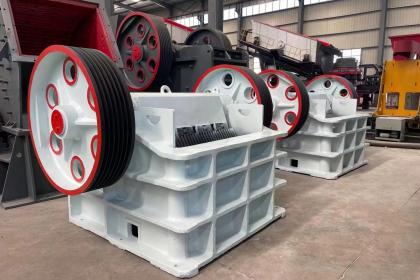
为您提供鄂式破碎机移动式破碎机设备厂家直销PEX250×1200
颚式破碎机又作鄂式破碎机,简称颚破,主要用于对各种矿石与大块物料的中等粒度破碎,广泛运用于矿山、冶炼、建材、公路、铁路、水利和化工等行业。被破碎物料的抗压强度为320MPa。性能特点为破碎比大,产品粒度均匀,结构简单,性能可靠,维修简便,运营费用低。
基本简介
本系列鄂式破碎机( 颚式破碎机),具有破碎比大、产品粒度均匀、结构简单、工作可靠、维修简便、运营费用经济等特点。颚式破碎机广泛应用于矿山、建材、化工、冶金等行业,可对抗压强度不大于320MPa的各种矿石、岩石等物料进行粗、中碎作业,是矿石破碎机、煤矸石破碎机等矿石物料破碎的设备。
颚式破碎机在矿山、建材、基建等部门主要用作粗碎机和中碎机。按照进料口宽度大小来分为大、中、小型三种,进料口宽度大于600MM的为大型机器,进料口宽度在300-600MM的为中型机,进料口宽度小于300MM的为小型机。颚式破碎机结构简单,制造容易,工作可靠,使用维修方便。
颚式破碎机的工作部分是两块颚板,一是固定颚板(定颚),垂直(或上端略外倾)固定在机体前壁上,另一是活动颚板(动颚),位置倾斜,与固定颚板形成上大下小的破碎腔(工作腔)。活动颚板对着固定颚板做周期性的往复运动,时而分开,时而靠近。分开时,物料进入破碎腔,成品从下部卸出;靠近时,使装在两块颚板之间的物料受到挤压,弯折和劈裂作用而破碎。
颚式破碎机按照活动颚板的摆动方式不同,可以分为简单摆动式颚式破碎机(简摆颚式破碎机)。复杂摆动式颚式破碎机(复摆颚式破碎机)和综合摆动式颚式破碎机三种。
工作原理
单摆颚式破原理
动颚悬挂在心轴上,可作左右摆动。偏心轴旋转时,连杆做上下往复运动,带动两块推力板也做往复运动,从而
推动动颚做左右往复运动,实现破碎和卸料。此种破碎机采用曲柄双连杆机构,虽然动颚上受有很大的破碎反力,而其偏心轴和连杆却受力不大,所以工业上多制成大型机和中型机,用来破碎坚硬的物料。此外,这种破碎机工作时,动颚上每点的运动轨迹都是以心轴为中心的圆弧,圆弧半径等于该点至轴心的距离,上端圆弧小,下端圆弧大,破碎效率较低,其破碎比一般为3-6.由于运动轨迹简单,故称简单摆动颚式破碎机。
简摆颚式破碎机结构紧凑简单,偏心轴等传动件受力较小;由于动颚垂直位移较小,加工时物料较少有过度破碎的现象,动颚颚板的磨损较小。
复摆颚式破原理
动颚上端直接悬挂在偏心轴上,作为曲柄连杆机构的连杆,由偏心轴的偏心直接驱动,动颚的下端铰连着推力板支撑到机架的后壁上。当偏心轴旋转时,动颚上各点的运动轨迹是由悬挂点的圆周线(半径等于偏心距),逐渐向下变成椭圆形,越向下部,椭圆形越偏,直到下部与推力板连接点轨迹为圆弧线。由于这种机械中动颚上各点的运动轨迹比较复杂,故称为复杂摆动式颚式破碎机。
复摆式颚式破碎机与简摆式相比较,其优点是:质量较轻,构件较少,结构更紧凑,破碎腔内充满程度较好,所装物料块受到均匀破碎,加以动颚下端强制性推出成品卸料,故生产率较高,比同规格的简摆颚式破碎机的生产率高出20-30%;物料块在动颚下部有较大的上下翻滚运动,容易呈立方体的形状卸出,减少了像简摆式产品中那样的片状成分,产品质量较好。
We provide jaw cers, mobile cers, and other cing equipment - Factory direct sales PEX250x1200.
The jaw cer, also known as a jaw breaker, is mainly used for medium cing of various ores and large materials. It is widely used in mining, smelting, building materials, highways, railways, water conservancy, and chemical industries. The maximum compressive strength of the material to be ced is 320MPa. Its performance features include a large cing ratio, uniform product particle size, simple structure, reliable performance, easy maintenance, and low operating costs.
Basic Introduction
This series of jaw cers features a large cing ratio, uniform product particle size, simple structure, reliable operation, easy maintenance, and economical operating costs. The jaw cer is widely used in mining, building materials, chemical, and metallurgical industries. It can perform coarse and medium cing on various ores, rocks, and other materials with a compressive strength not exceeding 320MPa, making it the preferred equipment for ore cers, coal gangue cers, and other mineral material cing.
In mining, building materials, and infrastructure departments, the jaw cer is mainly used as a coarse cer and medium cer. Classified by feed opening width, there are three types: large, medium, and small. Machines with a feed opening width greater than 600mm are large, those between 300-600mm are medium, and those less than 300mm are small. The jaw cer has a simple structure, is easy to manufacture, works reliably, and is convenient to use and maintain.
The working part of the jaw cer consists of two jaw plates: one is the fixed jaw plate (fixed jaw), which is vertically (or slightly inclined outward at the top) fixed on the front wall of the body; the other is the movable jaw plate (movable jaw), which is inclined and forms a cing chamber (working chamber) that is larger at the top and smaller at the bottom with the fixed jaw plate. The movable jaw plate performs periodic reciprocating motion against the fixed jaw plate, alternately separating and closing. When separating, material enters the cing chamber, and the finished product is discharged from the bottom; when closing, the material between the two jaw plates is ced by compression, bending, and splitting.
According to the different swinging modes of the movable jaw plate, jaw cers can be divided into three types: simple swing jaw cer, complex swing jaw cer, and combined swing jaw cer.
Working Principle
Principle of Simple Swing Jaw Cer
The movable jaw is suspended on the eccentric shaft and can swing left and right. When the eccentric shaft rotates, the connecting rod performs an up-and-down reciprocating motion, driving two thrust plates to also perform reciprocating motion, thereby pushing the movable jaw to perform left-and-right reciprocating motion to achieve cing and discharging. This type of cer adopts a crank double connecting rod mechanism. Although the movable jaw is subjected to a large cing reaction force, the eccentric shaft and connecting rod are subjected to less force. Therefore, it is mostly made into large and medium-sized machines in industry to c hard materials. In addition, when this cer works, the motion trajectory of each point on the movable jaw is an arc with the eccentric shaft as the center, where the radius of the arc equals the distance from that point to the axis. The upper arc is small, and the lower arc is large, resulting in a lower cing efficiency, and the cing ratio is generally 3-6. Due to the simple motion trajectory, it is called a simple swing jaw cer.
The simple swing jaw cer has a compact and simple structure, and the transmission parts such as the eccentric shaft are subjected to less force; since the vertical displacement of the movable jaw is small, there is less over-cing of the material during processing, and the wear of the movable jaw plate is small.
Complex swing jaw cer.
Compared with the simple swing jaw cer, the complex swing jaw cer has the advantages of being lighter in weight, having fewe components, and a more compact structure. The cing chamber is better filled, and the material blocks undergo uniform cing. Additionally, the forced discharge of finished products at the lower end oe moving jaw results in a higher production rate, which is 20-30% higher than that of a simple swing jaw cer of the same specifications. The material blocks experience significvertical tumbling motion at the lower part of the moving jaw, making it easier to discharge in a cubic shape, reducing the flaky components found in simple swing products, and resultitter product quality.