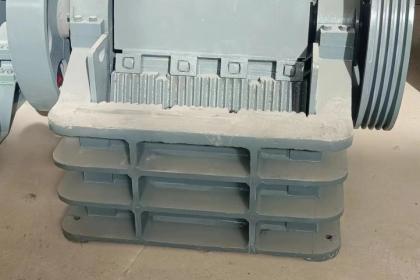
鄂式破碎机移动破碎机灵活便捷适应各种工PEX150×500
颚式破碎机简单摆动和复杂摆动的区别
颚式破碎机(颚破)分简单摆动颚式破碎机和复杂摆动颚式破碎机两种类型,它们的工作原理很相似,动颚的运动轨迹有较大的差别。简单摆动颚式破碎机,因动颚是悬挂在支承轴上,所以当动颚作往复运动时,动颚上各点的运动轨迹都是圆弧形,而且水平行程上小下大,而以动颚的底部(排矿口处)为。由于落入破碎腔的矿石,上部均为大矿块,往往达不到矿石破碎所必需的压缩量,故上部的大块矿石,需反复压碎多次,才能破碎。破碎负荷大都集中在破碎腔的下部,整个颚板没有均匀工作,从而降低了破碎机的生产能力。同时这种破碎机的垂直行程小,磨剥作用小,排矿速度慢。但颚板的磨损较轻,产品过粉碎少。复杂摆动颚式破碎机,由于其动颚又是曲柄连杆机构的连杆,在偏心轴的带动下,动颚上点的运动轨迹近似椭圆形,椭圆度是上小下大,其上部则近似圆形。这种破碎机的水平行程正好与简摆颚式破碎机相反,其上部大下部小,上部的水平行程约为下部的1.5倍,这样就可以满足破碎腔上部大块矿石破碎所需的压缩量。同时整个动颚的垂直行程都比水平行程大,尤其是排矿口处,其垂直行程约为水平行程的3倍,有利于促进排矿和提高生产能力。实践表明,在相网条件下,复摆颚式破碎机的生产能力比简摆颚式破碎机高30%左右。但颚板的磨损快,产品过粉碎严重。
主要特点
1、破碎腔深而且无死区,提高了进料能力与产量。
2、其破碎比大,产品粒度均匀。
3、垫片式排料口调整装置,可靠方便,调节范围大,增加了设备的灵活性。
4、润滑系统可靠,部件更换方便,设备维护保养简单。
5、结构简单,工作可靠,运营费用低。
6、设备节能:单机节能15%~30%,系统节能一倍以上。
7、排料口调整范围大,可满足不同用户的要求。
8、噪音低,粉尘少。
运行环境
在将巨大石块破碎成小石块的过程中,道破碎机通常为“主”破碎机。历史长,也坚固的破碎机是颚式破碎机。为颚式破碎机喂料时,物料从顶部入口倒入含有颚齿的破碎室,颚齿以巨大力量将物料顶向室壁,将之破碎成更小的石块。支持颚齿运动的是一根偏心住,此偏心轴贯穿机身构架。偏心运动通常由固定在轴两端的飞轮所产生。飞轮和偏心支持轴承经常采用球面滚子轴承,轴承的工作环境极为苛刻。轴承必须承受巨大的冲击载荷,磨蚀性污水和高温。尽管此工作环境极为苛刻,颚式破碎机仍需非常可靠的工作,这是保证生产效率的关键一环。
主要部件
1.机架
机架是上下开口的四壁刚性框架,用作支撑偏心轴并承受破碎物料的反作用力,要求有足够的强度和刚度,一般用铸钢整体铸造,小型机也可用优质铸铁代替铸钢。大型机的机架需分段铸成,再用螺栓牢固链接成整体,铸造工艺复杂。自制小型颚式破碎机的机架也可用厚钢板焊接而成,但刚度较差。
2.颚板和侧护板
定颚和动颚都由颚床和颚板组成,颚板是工作部分,用螺栓和楔铁固定在颚床上。定颚的颚床就是机架前壁,动颚颚床悬挂在周上,要有足够的强度和刚度,以承受破碎反力,因而大多是铸钢或铸铁件。
3.传动件
偏心轴是破碎机的主轴,受有巨大的弯扭力,采用高碳钢制造。偏心部分须精加工、热处理、轴承衬瓦用巴氏合金浇注。偏心轴一端装带轮,另一端装飞轮。
4.调节装置
调节装置有楔块式,垫板式和液压式等,一般采用楔块式,由前后两块楔块组成,前楔块可前后移动,顶住后推板;后楔块为调节楔,可上下移动,两楔块的斜面倒向贴合,由螺杆使后楔块上下移动而调节出料口大小。小型颚式破碎机的出料口调节是利用增减后推力板支座与机架之间的垫片多少来实现。
5.飞轮
颚式破碎机的飞轮用以存储动颚空行程时的能量,再用于工业形成,使机械的工作符合趋于均匀。带轮也起着飞轮的作用。飞轮常以铸铁或铸钢制造,小型机的飞轮常制成整体式。飞轮制造,安装时要注意静平衡。
6.润滑装置
偏心轴轴承通常采用集中循环润滑。心轴和推力板的支撑面一般采用润滑脂通过手动油枪给油。动颚的摆角很小,使心轴与轴瓦之间润滑困难,常在轴瓦底部开若干轴向油沟,中间开一环向油槽使之连通,再用油泵强制注入干黄油进行润滑。
折叠颚式破碎机与粗碎圆锥破碎机比较
粗碎圆锥破碎机与颚式破碎机相比,各有优缺点。
粗碎圆锥破碎机优点:生产率大,电能消耗少,工作较平稳,振动小,破碎比大,产品粒度较均匀,任何一方都能给矿,并可挤满给矿。缺点:构造复杂,设备费用大,机身高,需要叫高的厂房,极其笨重,不便搬运,不宜破碎粘性矿石,操作维护较复杂。
颚式破碎机优点:构造简单,制造成本低,检修维护方便,工作可靠,机器高度小,便于配置,对于水分高黏性大的矿石不易堵塞。缺点:生产率低,电能消耗大,振动较大,破碎比小,产品粒度不够均匀,不能挤满给矿。
[2]在选择粗碎设备时,要根据不同情况进行的分析比较。一般大型选矿厂多用粗碎圆锥破碎机。中、小型选矿厂,尤其是处理黏性物料时,宜选用颚式破碎机。通常对破碎机的选择都先要经过计算及技术经济比较后,才能确定。
Jaw Cer_Mobile Cer Flexible and Convenient, Adapt to Various Works PEX150×500
The Differtween Simple Swing and Complex Swing Jaw Cers
Jaw cers (Jaw Breakers) are divided into two types: simple swing jaw cers and complex swing jaw cers. Their workininciples are very similar, but the motion trajectories of the moving jaw differ significantly. In a simple swing jaw cer, since the moving jaw is suspended on a support shaft, when thjaw performs reciprocating motion, the motion trajectories of all points on the moving jaw are arc-shaped. The horizontal stroke is smaller at the top and larger at the bottom, withum occurring at the bottom of the moving jaw (the discharge opening). Since the ore falling into the cing chamber consists of large blocks at the top, the required compression for cing not achieved. Therefore, the large blocks at the top need to be ced repeatedly before they can be broken. The cing load is concentrated in the lower part of the cing chamd the entire jaw plate does not work uniformly, thereby reducing the cer's production capacity. At the same time, this cer has a small vertical stroke, weak grinding action, and slow disharge speed. However, the wear on the jaw plate is relatively light, and over-pulverization of the product is minimal. In a complex swing jaw cer, since the movaw also acts as the connecting rod of the crank-connecting rod mechanism, driven by the eccentric shaft, the motion trajectory of the points on the moving jaw is approximately elliptical. Thelipticity is smaller at the top and larger at the bottom, with the top being nearly circular. The horizontal stroke of this cer is exactly opposite to that of the simple swing cer; it is larger at the top and smaller at the bottom, with the horizontal stroke at the top being about 1.5 times that of the bottom. This allows for the compress required to c the large ore blocks in the upper part of the cing chamber. At the same time, the vertical stroke of the entire moving jaw is larger than the horizontal stroke, eially at the discharge opening, where the vertical stroke is about three times the horizontal stroke, which is conducive to promoting discharge and improving production capacity. Practice shows that under similar conditions, the product capacity of the complex swing jaw cer is about 30% higher than that of the simple swing jaw cer. However, the wear on the jaw plate is faster, over-pulverization of the product is severe.
Main Features
1. Deep cing chamber with no dead zone, improving feeding capacity and output.
2. Large cing ratio and uniform product pticle size.
3. Wedge-type discharge opening adjustment device, reliable and convenient, with a large adjustment range, increasing equipment flexibility.
4. Safe and reliable lubrication system, convenient componentreplacement, and simple equipment maintenance.
5. Simple structure, reliable operation, and low operating costs.
6. Energy-saving equipment: single machine saves 15–30% energy, and system saves more than one-fold energy.
7. Large discharge opening adjustment range, meeting the requirements of diff
8. Low noise, low dust.
Operating Environment
In the process of cing huge rocks into small stones, thetage cer is usually the "primary" cer. The oldest and most robust cer is the jaw cer. When feeding a jaw cer, the material is poured into the cing chamber thrhe top inlet, which contains jaw teeth. The jaw teeth push the material against the chamber walls with tremendous force, cing it into smaller stones. Supporting the movement of the jaw teeth is entric shaft that runs through the machine frame. The eccentric motion is usually generated by flywheels fixed to both ends of the shaft. Flywheels and eccentric support bearings often use spheler bearings, as the working environment is extremely harsh. Bearings must withstand huge impact loads, abrasive sludge, and high temperatures. Despite this extremely harsh working environment, the jaw cer operate very reliably, which is a key link in ensuring production efficiency.
Main Components
1. Frame
The frame is a rigid four-walled structure with openings at the topbottom, used to support the eccentric shaft and withstand the reaction force of the ced material. It requires sufficient strength and rigidity. It is generally integrally cast from cast steeall machines, high-quality cast iron can be used instead of cast steel. For large machines, the frame must be cast in sections and then firmly bolted together to form a w, making the casting process complex. The frame of a self-made small jaw cer can also be welded from thick steel plates, but the rigidity is relatively poor.
2. Jaw Plaand Side Liners
Both the fixed jaw and the movable jaw consist of a jaw bed and a jaw plate. The jaw plate is the working part, fixed to the jaw bed wiolts and wedges. The jaw bed of the fixed jaw is the front wall of the frame, while the jaw bed of the movable jaw is suspended on the shaft. It must have sufficistrength and rigidity to withstand the cing reaction force, so it is mostly made of cast steel or cast iron.
3. Transmission Parts
The eccentric shaft is the main shaft ofthe cer, subjected to huge bending and torsional forces, and is made of high-carbon steel. The eccentric part must be precision machined and heat treated, and the bearing is cast with Babbitt metal. A pulley is mounted on one end of the eccentric shaft, and a flywheel is mounted on the other end.
4. Adjustment Devicment devices include wedge type, shim type, and hydraulic type, etc. The wedge type is generally adopted, consisting of front and rear wedges. The front wedge can move forward backward to push against the rear thrust plate; the rear wedge is the adjusting wedge and can move up and down. The inclined surfaces of the two wedges fit together, and size of the discharge opening is adjusted by moving the rear wedge up and down via a screw rod. For small jaw cers, the discharge opening adjustment is achieved by adding or removing shimseen the rear thrust plate support and the frame.
5. Flywheel
The flywheel of the jaw cer is used to store energy during the idle stroke of the movable jaw andse it during the cing stroke, making the mechanical work uniform. The pulley also serves as a flywheel. The flywheel is often made of cast iron or cast steel,the flywheel of small machines is often made as a monolithic unit. Attention must be paid to static balance during the manufacture and installation of t
6. Lubrication System
Eccentric shaft bearings usually adopt centralized circulating lubrication. The support surfaces of the spindle and thrust plate arally lubricated with grease via a manual grease gun. The oscillation angle of the movable jaw is very small, making lubrication between the spindle and the bearing bush difficult; therefeveral axial oil grooves are often cut into the bottom of the bearing bush, connected by a circumferential oil groove in the middle, and dry grease is forced in byoil pump for lubrication.
Comparison between Folding Jaw Cers and Coarse Cone Cers
Compared with jaw cers, coarse cone cers have their respective advantages and disadvantages.
Advantages of coarse cne cers: high production capacity, low power consumption, smooth operation, low vibration, high reduction ratio, relatively uniform product size, capable of feeding from any side, and suitable for coke feeding. Disadvantages: complex structure, high equipment cost, high machine height requiring a tall workshop, extremely heavy and difficult to transport, unsuitable for cing sticky ores, and complperation and maintenance.
Advantages of jaw cers: simple structure, low manufacturing cost, convenient maintenance, reliable operation, low machine height facilitating layout, and less prone to blockage when prossing high-moisture and highly adhesive ores. Disadvantages: low production capacity, high power consumption, significant vibration, low reduction ratio, uneven product size, and inability to phoke feeding.
[2] When selecting coarse cing equipment, a comprehensive analysis and comparison should be conducted based on specific conditions. Generally, large-scale mineral processing plants mostly use coarse cne cers. Medium and small-scale plants, especially when processing sticky materials, are better suited for jaw cers. Typically, the selection of cers must be determined only after calculations and technical-economic