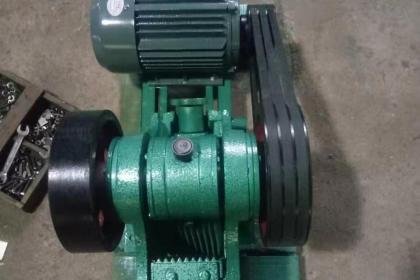
鄂式破碎机批发价格优质货源PE60×100
常见故障
故障介绍
颚式破碎机在运行过程中承受力矩或振动较大,常会造成传动系统故障,常见的有:皮带轮与轴头部位产生间隙造成的轴头与轮毂磨损,偏心轴受力造成的轴承位磨损等。
出现上述问题后传统维修方法是将轮毂扩孔,补焊或刷镀后机加工修复为主,但两者均存在一定弊端:补焊高温产生的热应力无法完全消除,易造成材质损伤,导致部件出现弯曲或断裂;而电刷镀受涂层厚度限制,容易剥落,且以上两种方法都是用金属修复金属,无法改变“硬对硬”的配合关系,在各力综合作用下,仍会造成再次磨损。
上述维修方法在西方国家已不常见,当代欧美等发达国家针对以上问题多使用高分子复合材料的修复方法,应用成熟的是美国福世蓝技术,其具有的粘着力,优异的抗压强度等综合性能,可免拆卸、免机加工进行现场修复。用高分子材料维修既无补焊热应力影响,修复厚度也不受限制,同时产品所具有的金属材料不具备的退让性,可吸收设备的冲击震动,避免再次磨损的可能,并大大延长设备部件的使用寿命,为企业节省大量的停机时间,创造巨大的经济价值。
故障排除
常见到经检修和初次安装的锤片式粉碎机在试运转中机身发生强烈振动。出现这种情况主要有以下几个原因:
(1)检修装配中锤片安装错误。锤片换面掉头使用时,为防止转子重量失去平衡,粉碎机内所有的锤片必须一齐换面掉头,否则会在运行中发生强烈振动。
(2)对应两组锤片重量之差超过5克。排除的方法是调整锤片重量,使相应两组重量之差少于5克。
(3)个别锤片卡得太紧,运行中没有甩开。可停机后用手转动观察,想办法使锤片转动灵活。
(4)转子上其他零件重量不平衡,这时需要分别仔细检查调整平衡。
(5)主轴弯曲变形。解决的办法是校直或更换。
(6)轴承间隙超过极限或损坏。一般都采用更换新轴承才能解决问题。
维修方法
1. 颚式破碎机润滑
(1) 经常注意并及时做好摩擦面得润滑工作,可确保机器的正常运转和延长其使用寿命。
(2) 颚式破碎机所采用润滑脂应根据使用的地点、气温条件下而定,一般情况下采用钙基、钠基和钙钠基润滑脂。
(3) 加入轴承座内的润滑脂为其空间容积的50%左右、每3~6个月更换一次。换油时应用洁净的汽油或煤油清洗滚柱轴承的滚道。
(4) 颚式破碎机开动前,推力板与推力板支座之间应注入适量的润滑脂。
2. 颚式破碎机维修
为保证颚式破碎机的正常工作,除正确操作外,必须进行计划性维修,其中包括日常维护检查,小修、中修和大修。
(1) 小修主要内容包括检查并修复调整装置,调整排料口间隙,对磨损的衬板调头或更换。检查传动部分、润滑系统及时跟换润滑油等。小修的周期为1~3个月左右。
(2) 中修处进行小修的工作外,还包括更换推力板、衬板、检查并修复轴瓦等。中修的周期一般为1~2年左右。
(3) 大修 处进行中修的工作外,还包括和更换车削偏心轴和鄂心轴,浇铸连杆头上部的巴氏合金,更换或修复个磨损件。大修的周期一般为5年左右。
注意事项
(1) 破碎机正常运转后,方可投料生产。
(2) 待碎物料应均匀地加入破碎机腔内,应避免侧向加料或堆满加料,以免单边过载或承受过载。
(3) 正常工作时,轴承的温升不应该超过30℃,温度不得超过70℃。超过上述温度时,应立即停车,查明原因并加以排除。
(4) 停车前,应首先停止加料,待破碎腔内物料完全排出后,方可关闭电源。
(5) 破碎时,如因破碎腔内物料阻塞而造成停车,应立即关闭电源停止运行,将破碎腔内物料清理干净后,方可再行起动。
(6) 颚板一端磨损后,可调头使用。
(7) 破碎机使用一段时间后,应将紧定衬套松动而损伤机器。
选材组装
设计、选材
在设计时,动颚和定颚的破碎板应该齿峰对齿谷。这样,破碎时对物料除了有挤压作用外,还有弯曲作用,物料比较容易破碎。为了加强破碎板的使用寿命,中小型破碎机的破碎板设计成 上下对称的形状,当下部磨损后可调头使用;大型颚式破碎机的破碎板设计成互相对称的几块,以便磨损后可将破碎板调换使用。破碎板的材料可以选用白口铸铁。白口铸铁硬度较大、耐 磨性较好、来源容易、价格便宜;缺点是性脆、容易折断、使用寿命短。为了提高破碎板的使用寿命,材料采用含锰12 %以上的锰钢更好,常用的是ZGMn13。锰钢的韧性较好,虽然硬度不高 (大约为210 HB),但是,因为具有冷加工硬化的特点,在压力作用下会不断被强化,故在工作中不断磨损又不断强化,直到磨损至不能使用才报废。锰钢破碎板浇铸后要通过水韧处理,水韧 处理的操作大体上与淬火相同,即把铸造出来的锰钢破碎板加热到1 000~1 100 ℃后在水中快速冷却。水韧处理后可以得到均匀的金相组织,并使金相组织固定下来,避免了在使用中自然 发生相变而使性能变差。锰钢的缺点是价格较贵,但从使用寿命、成本等方面总体考虑,ZGMn13 比白口铸铁使用寿命长、成本低。
组装
组装时,破碎板必须牢固地贴在鄂板上,两者之间应该垫平,破碎板与颚板之间要用软金属(如铅、锌等) 作垫片,并用螺栓紧固。破碎机工作时,破碎板不应有松动现象,否则容易折断或 磨损破碎板,降低破碎板的使用寿命。所以,组装时一定要安装好破碎板,从而延长破碎板的使用寿命。
使用过程中改进以加强破碎板的寿命 在生产过程中,破碎板与物料直接作用,破碎力很大,特别是破碎硬度较大的物料时,导致安装破碎板的螺栓振动,螺母松动,使破碎板磨损加剧并产 生极大的噪音,严重时破碎板脱落或折断使设备停机,影响正常生产。遇到这种情况,只是开机前拧紧螺栓、螺母是不能彻底解决问题的,要根据现场的实际情况具体问题具体分析,想办法 采取切实可行的方法解决问题。例如,可以采用弹簧防松减振装置解决破碎板在工作中的松动,从而延长破碎板的使用寿命,提高工作效率。具体做法是利用弹簧做成螺栓防松动及自紧装 置,该装置由内弹簧压盖、弹簧、外弹簧压盖组成,把这个装置穿在螺栓上拧紧螺母,由于弹簧被螺母压紧到一定程度后,产生很强的防振效果,由巨大的破碎力产生的螺栓松动力被弹簧张 紧力自动弥补,故螺栓不致于松动,从而延长破碎板的使用寿命,提高生产效率。总之,在使用过程中可以针对具体情况想办法解决具体问题,防止破碎板松动、磨损加剧、折断等情况,从而 延长破碎板的使用寿命,降低成本,提高工作效率。
结论
加强颚式破碎板使用寿命从设计选材、组装、使用过程中的改进等方面着手,能很好地加强颚破破碎板使用寿命,从而提高颚式破碎机的生产效率,降低生产成本。
Jaw Cer - Wholesale Price - High-Quality PE60x100
Common Faults
Fault ntroduction
During operation, jaw cers are subjected to significant torque or vibration, which often leads to transmission system failures. Common issues include: wear between the shaft head and hub caused by clear between the pulley and shaft head, and wear on the bearing position caused by forces acting on the eccentric shaft.
After such problems occur, traditional repair methods primarily involve enlarging he hub hole, followed by machining restoration after welding or b plating. However, both methods have inherent drawbacks: the thermal stress generated by welding at high temperatures cannot be completely eliminated, easily causerial damage and leading to component bending or fracture; while b plating is limited by coating thickness and is prone to peeling. Furthermore, both methods involve repairing metal with me, failing to change the "hard-on-hard" mating relationship. Under the combined action of various forces, re-wear will still occur.
The above repair methods are no longer common in Westen countries. Developed countries in Europe and America now mostly use high-performance polymer composite materials to address these issues. The most mature application is the American Fushiluan technology, which featuresior adhesion and excellent compressive strength. It allows for on-site repair without disassembly or machining. Repairing with polymer materials eliminates the influence of welding thermal stress and is not limitir thickness. Additionally, the material's resilience, which metal lacks, can absorb impact vibrations from the equipment, avoiding the possibility of re-wear and significantly extending the service life ofonents. This saves enterprises substantial downtime and creates significant economic value.
Troubleshooting
It is common to observe severe vibration of the machine body during trial operation of hammer cers after maintenancinstallation. This situation is mainly caused by the following reasons:
(1) Incorrect installation of hammer blades during maintenance assembly. When reversing the hammer blades for use, all blades insidecer must be reversed together to prevent rotor imbalance; otherwise, severe vibration will occur during operation.
(2) The weight difference between corresponding pairs of hammer blades exceeds 5 grams. solution is to adjust the weights of the hammer blades so that the difference between corresponding pairs is less than 5 grams.
(3) Individual hammer blades are jammed too tightly and swing freely during operation. The machine can be stopped and manually rotated to observe the issue, and measures should be taken to ensure the hammer blades move freely.
(4) Weight imbala other parts on the rotor. In this case, the balance needs to be checked and adjusted separately.
(5) Bending or deformation of the main shaft. The solution iso straighten or replace the shaft.
(6) Bearing clearance exceeds limits or the bearing is damaged. Generally, replacing the bearing with a new one is required to solve
Maintenance Methods
1. Jaw Cer Lubrication
(1) Pay constant attention to and ensure timely lu of friction surfaces to guarantee the normal operation of the machine and extend its service life.
(2) The grease used for the jaw cer should be selected based on the location and temperatures; generally, calcium-based, sodium-based, and calcium-sodium-based greases are used.
(3) The grease added to the bearing housing should occupy abouof the space volume, and it should be replaced every 3 to 6 months. When changing the oil, clean the raceways of the roller bearings with clean gasoline o kerosene.
(4) Before starting the jaw cer, an appropriate amount of grease should be injected between the thrust plate and the thrust plate support.
2. Jaw Cer Maintenance
To ensural operation of the jaw cer, in addition to correct operation, planned maintenance must be carried out, which includes daily maintenance checks, minor repairs, medium repairs, and majo repairs.
(1) The main content of minor repairs includes checking and repairing the adjusting device, adjusting the discharge opening clearance, turning or replacing worn liners. It also includes checking the transmission part lubrication system, and timely replacing lubricating oil. The cycle for minor repairs is approximately 1 to 3 months.
(2) In addition to the work of minor repdium repairs also include replacing thrust plates and liners, and checking and repairing bearing shells. The cycle for medium repairs is generally about 1 to 2 years.
(3) Ma repairs, in addition to the work of medium repairs, also include turning eccentric shafts and toggle shafts, casting Babbitt metal on the upper part of the connecting rod head, areplacing or repairing worn parts. The cycle for major repairs is generally about 5 years.
Precautions
(1) Feeding for production should only commence after the cer is runng normally.
(2) Material to be ced should be added uniformly into the cing chamber; avoid lateral feeding or overfilling to prevent unilateral overload or excessive load.
(3) Dal operation, the temperature rise of the bearings should not exceed 30°C, and the maximum temperature should not exceed 70°C. If the temperature exceeds these limi the machine immediately, identify the cause, and eliminate the problem.
(4) Before stopping, stop feeding first; wait until all material in the cing chamber is completely discharged before turff the power.
(5) During cing, if the machine stops due to material blockage in the cing chamber, immediately turn off the power to stop operation, clear the materthe cing chamber, and then restart.
(6) After one end of the jaw plate wears out, it can be turned around for continued use.
(7) After using theer for a period of time, loosen the locking sleeve to prevent damage to the machine.
Material Selection and Assembly
Design and Material Selection
In the design, the cing plates of the movable jaw and fixed jaw should arranged so that the peaks of the teeth align with the valleys of the teeth. This way, during cing, the material is subjected not only to compressive forces but also to benrces, making it easier to break. To extend the service life of the cing plates, those in medium and small cers are designed in an up-down symmetrical shape so that they canreversed for use after the lower part wears out; the cing plates in large jaw cers are designed as several mutually symmetrical pieces so that they can be interchanged after wear. The rial for the cing plates can be selected as white cast iron. White cast iron has high hardness, good wear resistance, is readily available, and is inexpensive; however, its disadvantages are brittleness, susceptibility to breakage, and a short service life. To improve the service life of the cing plates, materials with manganese steel containing more than 12% me are better, with ZGMn13 being the most commonly used. Manganese steel has good toughness; although its hardness is not high (approximately 210 HB), ossesses the characteristic of work hardening, meaning it is continuously strengthened under pressure. Therefore, during operation, it undergoes continuous wear and continuous strengthening until it is worn to the pof being unusable. After casting, manganese steel cing plates must undergo water toughness treatment. The operation of water toughness treatment is largely similar to quenching, which involves heating the cast maneel cing plates to 1000–1100 °C and then rapidly cooling them in water. Water toughness treatment results in a uniform microstructure and fixes the mirostructure, preventing natural phase transformations during use that would degrade performance. The disadvantage of manganese steel is its higher cost, but considering service life and cost comprehensivelyZGMn13 has a longer service life and lower cost than white cast iron.
Assembly
During assembly, the cing plate must be firmly attached to the jaw plate, with a flat surface betwee two. A soft metal (such as lead or zinc) should be used as a gasket between the cing plate and the jaw plate, and they should be secured with bolts. When ther is in operation, the cing plate must not be loose; otherwise, it is prone to breakage or excessive wear, shortening its service life. Therefore, it is essential tothe cing plate properly during assembly to extend its service life.
Improvements during use to enhance the service life of the cing plate
During the production process, the cing plate interacts dtly with the material under high cing forces. Especially when cing hard materials, this causes vibration of the bolts securing the cing plate and loosening of the nuts, leading to accelerated wear and signiicant noise. In severe cases, the cing plate may fall off or break, causing equipment downtime and affecting normal production. In such situations, simply tightening the bolts and nuts before starting the mat completely solve the problem. Instead, specific problems must be analyzed based on the actual site conditions, and feasible methods must be adopted to resolve them. For example, a spriti-loosening and vibration-damping device can be used to prevent the cing plate from loosening during operation, thereby extending its service life and improving work efficiency. Specifically, a spring-bed anti-loosening and self-tightening device can be utilized, consisting of an inner spring cover, a spring, and an outer spring cover. This device is mounted on the bolt and the nut is tightened. Once the spring is compressed to a certain degree by the nut, it produces a strong vibration-damping effect. The loosening force generated by the huge cring force is automatically compensated by the spring tension, preventing the bolt from loosening. This extends the service life of the cing plate and improves production efficiency. In conclusion, during use, spec methods can be devised to address specific problems, preventing issues such as loosening, accelerated wear, and breakage of the cing plate, thereby extending its service life, reducing costs, aproving work efficiency.
Conclusion
By focusing on design and material selection, assembly, and improvements during use, the service life of the jaw cer cing plate can be significantly enhanced. This e production efficiency of the jaw cer and reduces production costs.